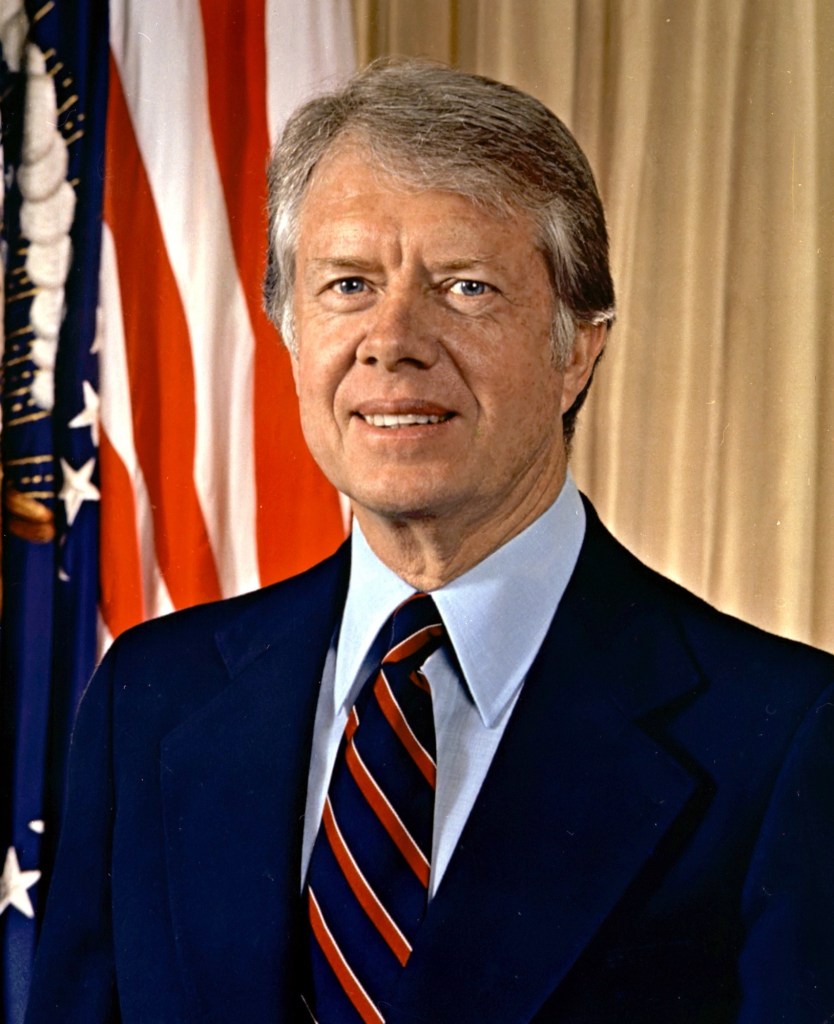
Tuesday, 1 October 2024, 39th US President, Jimmy Carter, in office from 1977 to 1981, has become the first US President in history to become 100 years old. To celebrate this milestone, the blog wants to remind its readers of five of his greatest accomplishments.
- Creation of the Department of Energy
On 4 August 1977, President Carter signed the “Department of Energy Organisation Act” into law. The DOE itself became operational on 1 October 1977.
The 1970s were indeed a challenging decade for American energy policy, especially from a security perspective, as primarily shown by the 1973 oil crisis, triggered by the OPEC embargo against the USA and Europe, due to the West’s support for Israel in the wars against its Arab neighbours. The oil embargo had disastrous impacts on the American economy, beyond shortages, including impacts on consumption and inflation. While President Carter encouraging Americans to “put on a sweater” to avoid excessive energy consumption fell flat, the Department of Energy (DOE) formation has been impactful for decades after his presidency.
The DOE was created in the context of needing to secure US energy supplies. Hence it was essential for various energy-related agencies which existed before to be consolidated into a single body. This body, the DOE, was tasked to develop longer term strategies to ensure energy security. Most importantly, the DOE promoted energy conservation, and the creation of infrastructure for the use of energy sources, alternative to foreign oil. While renewable energy was yet to become popular, the DOE played a significant role in promoting nuclear energy, as a result up to date nuclear energy is by far the biggest source of clean energy in the USA.
2. Camp David Accords
The Carter presidency saw by far the biggest progress towards peace in the Middle East, in comparison with previous Cold War presidencies. The Camp David Accords were signed on 17 September 1978 following twelve days of secret negotiations at Camp David between Israeli PM Menachem Begin and Egyptian President Anwar Sadat. While the process was started late into the Nixon presidency, and lasted during the Ford presidency, the Carter administration showed significant commitment since stepping into power. The most tangible result of the Accords has perhaps been that Egypt recognised Israel as a state, and that the two countries have enjoyed peaceful relations for over 45 years. In Cold War context, it is also important to consider that the USA brokering such a peace agreement was significant, as Egypt had not previously sided with the USA. Egypt, under President Nasser, was a leading power in the Non-Aligned Movement, however having received Soviet military support on numerous occasions, including in the 1967 Six Day War and in the 1973 Yom Kippur War.
3. Deregulation, especially airline deregulation
While Jimmy Carter’s successor, 40th President Ronald Reagan (in office 1981 to 1989) is often considered a great deregulator, and while Carter certainly did not have such a legacy in deregulating financial markets, Jimmy Carter can easily be considered a great deregulator in terms of industry. By the time President Carter took office in January 1977, there were various regulatory agencies, going as far back as FDR’s New Deal. While these agencies did much work which was considered positive, there were increasing concerns those agencies were susceptible to political capture or that they complicated needlessly stuff by setting rates and conditions for trains, trucks, pipelines, buses, and airlines. President Carter, almost immediately after taking office, started looking for ways in which to reduce these regulatory burdens, eventually cutting down paperwork, and eliminating a few agencies.
While decades later, there tends to be no consensus on was that deregulation a net positive, in the opinion of this blog, a specific industry in which President Carter’s deregulation efforts have to be considered is the airline industry.
The Airline Deregulation Act, signed into law on 24 October 1978, essentially eliminated the Civil Aeronautics Board (CAB). The CAB, even in the words of its then Chairman Alfred Kahn, an avowed liberal, led to problems such as nobody being able to fly a plane commercially on any route without direct permission by the CAB, also no one could ‘cut fares’ leading to poor price competition.
As a result of the Deregulation Act, federal government control over fares, routes, as well as market entry and exit was lifted. While some contentious issues did remain, in the 1990s it was estimated that fares had fallen significantly, and it had become apparent that many of the concerns such as smaller markets not being served were unfounded.
4. A human rights-led policy when dealing with the Soviet Union
Since the beginning of the Cold War in the late 1940s, different US administration had approached the Soviet Union and its attempts to spread communism differently. The Truman administration for example focused on “containment”, the Eisenhower administration had an even tougher position- that “rollback” was ideal.
The Nixon administration represented somewhat of a change, in the light of realist thinking, focusing on Detente, while still maintaining some previous doctrines, including communism in America’s own backyard being unacceptable.
Under the Ford administration, in 1975 the Helsinki Accords were signed. The Carter administration, however, became the administration that insisted on the human rights principles of the Helsinki Accords being followed through. While sceptics may argue this mostly took the form of raising awareness and of statements, it is hard to dispute it also gave a push to many dissident movements including in communist states of the Warsaw Pact. The Carter administration was also evidently less supportive of dictatorial regimes that were considered to be siding with the USA in the Cold War, such as the Videla regime in Argentina, precisely due to their poor human rights record.
5. Post-presidency achievements
While the previous four points all focused on presidency achievements, it is important to note that Jimmy Carter is often considered to have lived an exemplary post-presidential life. In 2002, he even received the Nobel Peace Prize for achievements in the human rights sphere. The Carter Presidential Center, founded in 1982, has been a consistent champion for the promotion of democracy and human rights. Throughout the years since leaving the White House in 1981, Carter has worked to settle disputes between the USA and some of the most volatile foreign leaders including dictator Kim Il-Sung of North Korea and Muammar Gadaffi of Libya. Carter has likewise worked for charities with causes such as providing housing for underprivileged people.
 Power & Politics Hub
Leave a comment